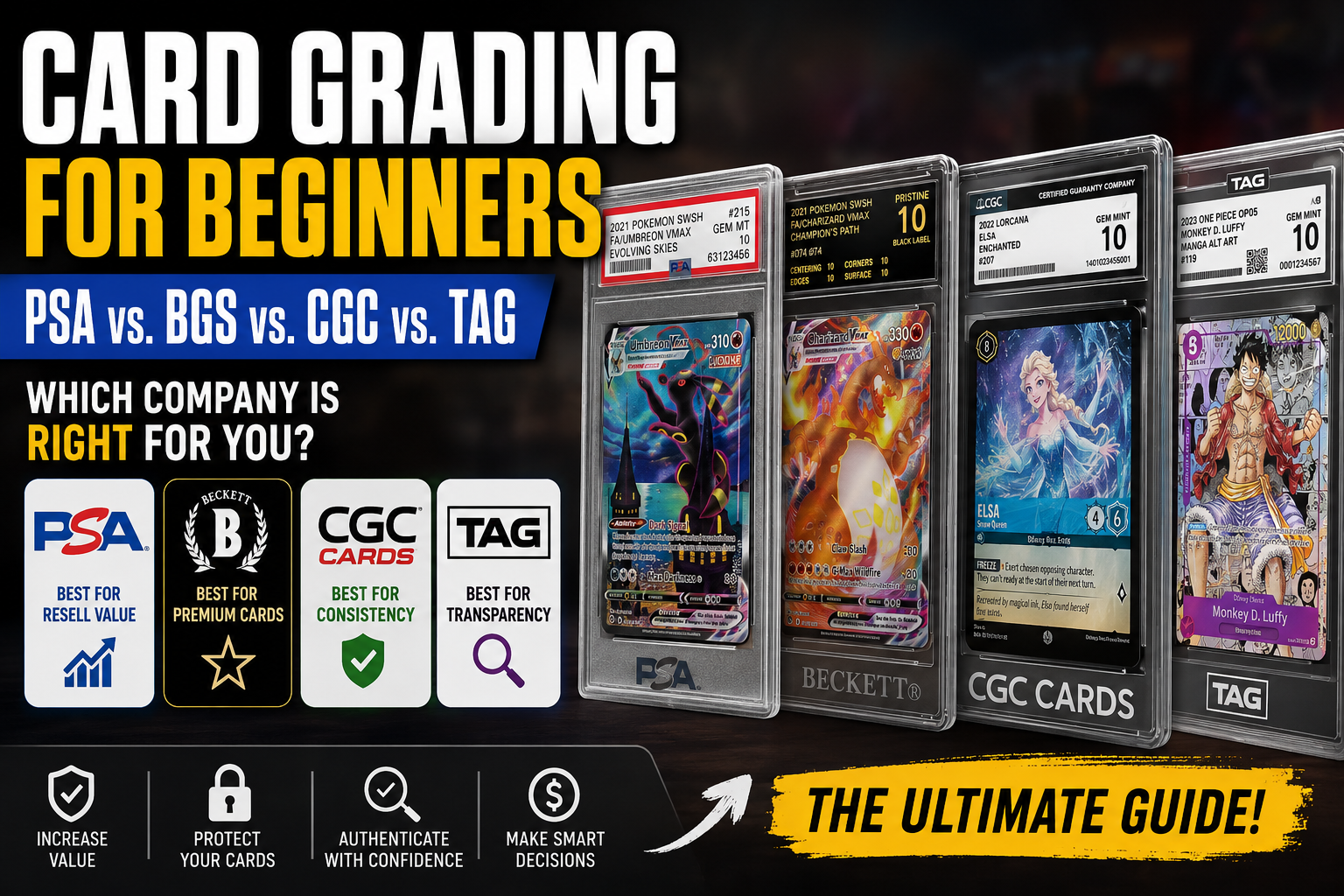
If you’ve spent any time collecting Pokémon, Magic: The Gathering, One Piece, Lorcana, sports cards, or just about any other trading card game, you’ve probably seen cards sealed inside hard plastic cases with labels displaying a number like PSA 10 or CGC 9.5.
Those are graded cards, and for many collectors they’re the gold standard for preserving valuable cards and proving their condition.
But should you get your cards graded? And if you do, which grading company should you choose?
What Is a Graded Card?
A graded card is a trading card that has been professionally inspected by an independent grading company. Experts evaluate the card’s condition, assign it a numerical grade (usually on a scale from 1 to 10), and seal it inside a tamper-evident plastic holder, commonly called a slab.
The grading process looks at several factors:
- Centering
- Corners
- Edges
- Surface quality
- Print defects
- Overall eye appeal
Generally speaking:
- 10 = Gem Mint (virtually flawless)
- 9 = Mint
- 8 = Near Mint-Mint
- 7 and below = Increasing signs of wear
Even two copies of the same card can have dramatically different values depending on their grade.
Why Do People Grade Cards?
There are several reasons collectors send cards in for grading.
1. Increase Resale Value
The biggest reason is simple: a high grade can significantly increase a card’s value.
For example: A raw card worth $100 might sell for $150 as a PSA 9 or $500+ as a PSA 10
This isn’t always true, but iconic cards and modern chase cards often command major premiums in top grades.
2. Protect the Card
Graded slabs protect cards from scratches, bending, moisture, fingerprints, and accidental damage. If you own a card worth hundreds or perhaps thousands of dollars, a slab provides excellent long-term protection.
3. Authenticate Expensive Cards
Counterfeit trading cards have become increasingly common and sometimes difficult to identify if you are unsure what to look for. Professional grading companies verify that your card is authentic before encapsulating it, giving buyers confidence that they’re purchasing the real thing.
4. Build a Collection
Many collectors simply enjoy owning professionally graded cards. Some build complete PSA 10 collections. Others collect only pristine vintage cards. Some enjoy the uniform appearance of slabs displayed on a shelf. There’s no wrong way to collect.
Should You Grade Every Card?
Absolutely not. Grading costs money, takes time, and doesn’t always increase a card’s value. Instead, ask yourself these questions.
Is the Card Valuable?
If the raw card is only worth $10 and grading costs $20–30, it probably isn’t worth grading unless it has sentimental value.
Is It in Excellent Condition?
A card with whitening, scratches, dents, or poor centering probably won’t receive a high enough grade to justify the grading fee. Modern cards often need to look nearly perfect to earn a Gem Mint 10.
Is It Rare?
Some cards deserve grading simply because they’re difficult to replace: First edition cards, Serialized cards, Promotional cards, Tournament prize cards, signed cards (when eligible for authentication), Reserved List Magic cards, Vintage Pokémon, Early sports cards.
Do You Plan to Sell It?
If you’re planning to sell a high-value card, grading can make it easier to sell because buyers know exactly what they’re getting.
Is It Sentimental?
Sometimes the answer isn’t financial at all. Maybe it’s the first booster pack you ever opened. Maybe it’s your childhood Charizard. Maybe it’s the commander you’ve played for years. Protecting memories is a perfectly valid reason to grade a card.
When Is Grading Not Worth It?
Grading usually isn't worthwhile if the card is heavily played or has obvious damage, the grading fee exceeds the card's value, you simply want to play with the card regularly, or you're submitting it solely because you expect it to receive a 10.
The Major Card Grading Companies
Today there are several respected grading companies, each with its own strengths.
PSA (Professional Sports Authenticator) is best for maximizing resale value.
| Pros | Cons |
|
|
|
Choose PSA if: You’re investing. You plan to resell. You want maximum market recognition. |
|
BGS (Beckett Grading Services) is best for modern cards. One feature that makes Beckett unique is subgrades. Instead of receiving only one overall grade, you will also receive grades for surface, centering, edges, and corners.
Collectors especially love the legendary Black Label 10, considered one of the hardest grades in the hobby to achieve.
| Pros | Cons |
|
|
|
Choose Beckett if you enjoy detailed grading, your card is exceptionally well-centered, or you're chasing a Black Label. |
|
CGC Cards is best for those who value consistency. CGC has become a major player in the trading card market and is widely respected for its grading consistency. Their holders are clean, durable, and attractive.
| Pros | Cons |
|
|
|
Choose CGC if you value grading accuracy. You’re building a personal collection, or you want quality grading without paying PSA premiums |
|
TAG (Technical Authentication & Grading) is best for technology-focused collectors. Although TAG is one of the newest grading companies, it's quickly gaining a healthy following
TAG uses machine-learning-powered computer vision to analyze cards for defects, damage, and imperfections. The system's findings are then reviewed by human grading experts before the grade is finalized. Every graded card includes a detailed digital report explaining exactly why it received its grade. Because of this, TAG is my preferred choice when getting my own cards graded.
| Pros | Cons |
|
|
|
Choose TAG if you value transparency, enjoy detailed grading reports, and are collecting rather than investing. |
|
Which Grading Company Should You Choose?
The best grading company depends on your goals.
| Your Goal | Recommended Company |
| High Resale Value | PSA |
| Premium Modern Cards | BGS |
| Consistent Grading | CGC |
| Transparency | TAG |
There isn’t one universally “best” grading company. Instead, choose the company that matches what matters most to you.
Tips Before Sending Cards for Grading
Before submitting cards:
- How much does it cost? Is it worth grading?
- Handle cards with clean hands or gloves.
- Use penny sleeves and semi-rigid card holders.
- Inspect cards under bright lighting.
- Look closely for scratches and dents.
- Compare your card to PSA or Beckett grading standards.
- Don’t assume every pack-fresh card will receive a 10.
A little preparation can save disappointment later.
Final Thoughts
Grading isn’t necessary for every card, but it can be one of the best ways to protect valuable collectibles, verify authenticity, and maximize resale value. Choose a company whose philosophy you like best. At the end of the day, the best graded card isn’t always the most expensive one; it’s the one that fits your goals as a collector.