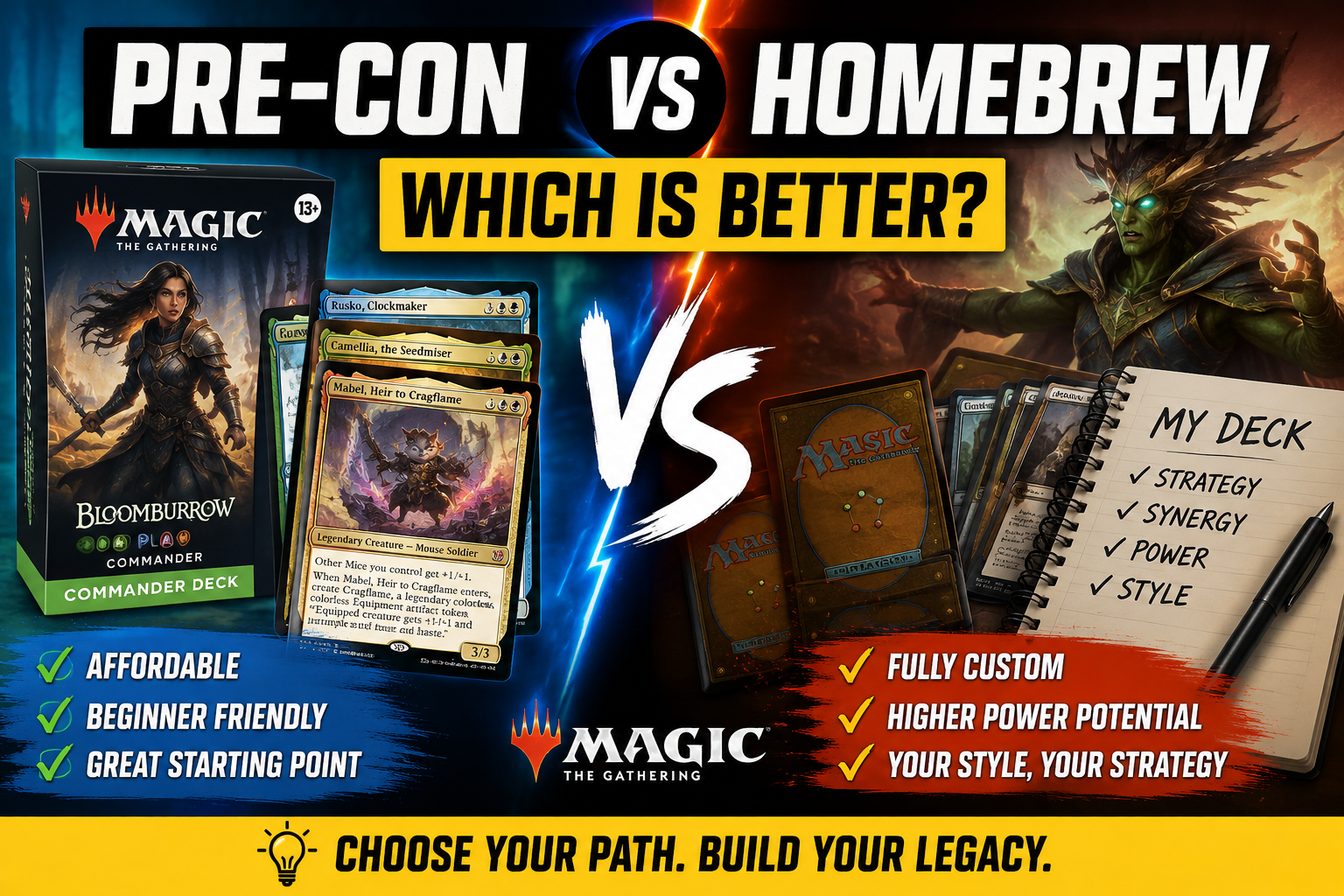
One of the many reasons we get sucked into Magic: The Gathering is the enjoyment of playing and building different decks. With countless mechanics, artistic styles, and new cards introduced every year, it’s hard to treat the game as a “one-and-done” experience.
The real challenge, though, is this:
Do you buy a pre-con, or build a homebrew deck?
Whichever direction you choose, both options come with their own pros and cons. Let’s break them down to help you decide which path is best for you.
Pre-Con Pros
1. Beginner Friendly:
Pre-constructed decks are designed with newer players in mind. They usually do a good job of demonstrating the core mechanics of a particular set or strategy in a clear and approachable way.
2. They are Affordable:
Because these decks are pre-constructed, they come at a fixed price—usually around $50 depending on the game and format. You also know exactly what you’re getting before you buy, which removes a lot of uncertainty.
3. Balanced Gameplay:
Pre-cons are generally designed to play well against other pre-cons. This makes them a great option for casual games where everyone wants a more balanced experience.
The Cons of Pre-Cons
While pre-cons are a great starting point, they do come with some drawbacks.
1. Lower Power Level:
These decks usually aren’t fully optimized. They often contain slower cards or filler cards from the set, making them less effective in competitive environments.
2. Lack of Personal Expression
Because pre-cons are designed to appeal to a wide audience, they can feel generic. You may find that the strategy doesn’t fully match your playstyle or that the theme isn’t exactly what you enjoy most.
3. Upgrades Are Almost Inevitable
Even if the deck works well out of the box, most players eventually want to improve it. Over time, you’ll likely invest in upgrades to make the deck more consistent, powerful, and personalized.
Homebrewed Decks
A homebrew, or custom-built deck, is the alternative option. These decks are typically tailored to the individual player’s preferred playstyle and thematic interests.
1. They are Tailored to You
One of the greatest advantages of a custom deck is that you already know what you want it to do. Whether your style is aggressive, control-oriented, combo-focused, or thematic, a custom deck allows you to build more efficiently around your goals.
2. Higher Power Potential
Because the deck is built from scratch, you can skip many of the weaknesses found in pre-cons and focus directly on consistency, speed, and synergy. In most cases, a well-built custom deck will outperform a pre-con.
3. Deeper Understanding of the Game
Building your own deck teaches valuable skills. You gain a stronger understanding of:
- Card evaluation
- Mana curves
- Deck balance
- Synergy and interactions
This knowledge makes you a better player overall.
The Cons of Custom Decks
1. Steeper Learning Curve
New players often struggle to understand why their decks don’t perform well. Without a proper understanding of strategy and synergy, even powerful individual cards can become weaknesses instead of strengths.
2. Higher Upfront Cost
Buying individual cards—especially popular staples—can become expensive quickly. For example, my cheapest custom deck currently sits around $120 market value, which is more than double the price of most pre-cons.
3. Risk of Imbalance
Without experience in deck building, it’s easy to create imbalance within your deck:
- Too much ramp
- Not enough removal
- Too many high-cost cards
- Not enough consistency
A deck may look powerful on paper but struggle in actual gameplay.
4. Time Investment
Building a custom deck takes time. Choosing a strategy is easy; finding the right cards that work together and fit your budget is much harder. Depending on your resources, it could take weeks or even months to finish the deck you envision.
Which Is Best?
Ultimately, the decision is yours to make. However, if you are a newer player—or simply don’t feel confident in deck building yet—a pre-con is usually the best place to start.
Pre-cons:
- Reduce decision-making
- Offer a fair and affordable entry point
- Provide a strong foundation for upgrades
- Teach core game mechanics naturally
Once you understand the fundamentals of the game and discover what you enjoy (and what you don’t), transitioning into custom deck building becomes far less overwhelming.
What’s the Best Path Forward?
In my own experience over the past couple of years, I’ve built decks from scratch, played pre-cons, and upgraded existing lists. While each approach has its strengths and weaknesses, I believe the easiest path forward starts with pre-cons.
Here’s the approach I recommend:
1. Find a pre-con that appeals to you based on its mechanics or theme.
2. Spend time learning how the deck functions and identifying its strengths and weaknesses.
3. Slowly upgrade the deck to better fit your playstyle.
4. Eventually, build your own deck from scratch.
Who knows? By the time you finish upgrading the pre-con, you may have changed so many cards that it becomes entirely your own unique creation.
This approach combines the stability of pre-cons with the creativity of custom deck building, giving both new and experienced players confidence and control over time.
There Is No Wrong Conclusion
There is no “wrong” way to approach deck building. It ultimately depends on:
- Your budget
- Your experience level
- How much time you want to invest
At the end of the day, the goal of any trading card game isn’t just to win—it’s to learn, explore, experiment, and have fun.
Choosing the right starting point simply helps make that journey even better.