
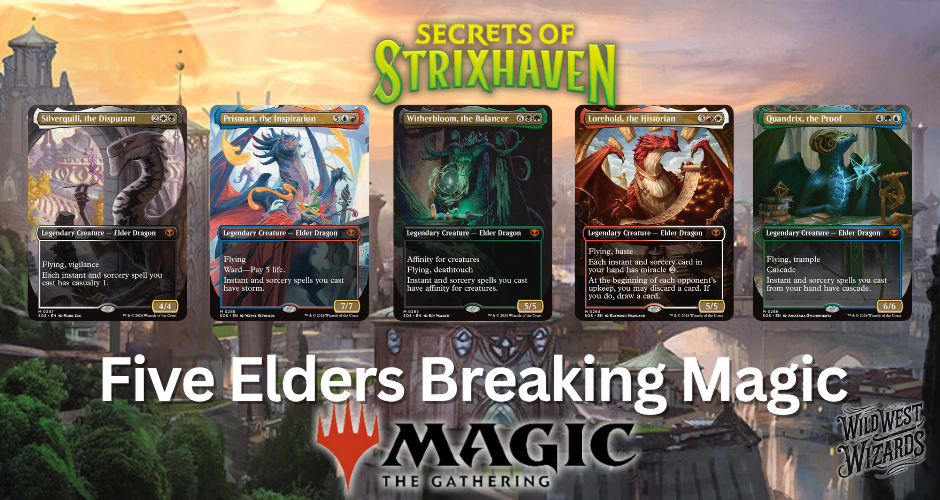
Spoiler season has finally begun for the upcoming MTG set: Secrets of Strixhaven. In this set, we return to the plane of Arcavios—but this time, we’re going beyond the university itself. The world is expanding, and with it come new mechanics we have yet to discover across the five colleges, such as “Prepared” and “Paradigm.”
While there certainly are too many cards to cover in one article, today’s reveals gave us something special: five brand-new Elder Dragons.
And these aren’t just strong cards. These are the kind of cards that would fundamentally warp how Magic: The Gathering is played. They’re not just splashy mythics—they’re engine cards. The kind that don’t ask for synergy… they create it on their own.
At first glance, I’ll admit—these massive dragons didn’t immediately spark my interest as an artifact lover. But the more I looked at them, the more I realized just how absurdly powerful they are—and how easily they could reshape MTG as we know it.
Silverquill the Disputant
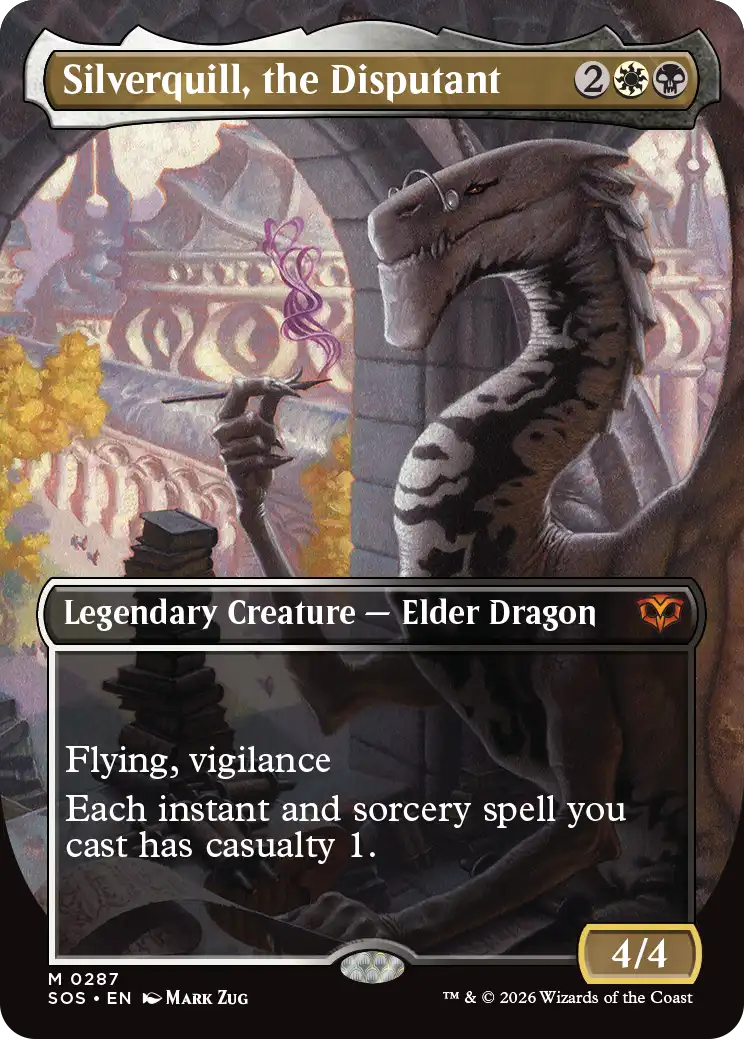
Casualty was first introduced in Streets of New Capenna.
Casualty reads:
“As you cast this spell, you may sacrifice a creature with power X or greater. When you do, copy this spell.”
Now imagine that ability stapled onto every instant and sorcery you cast.
This is straight-up mean.
I mean, who would really want to:
- Cast a tutor twice?
- Double your removal?
- Turn every draw spell into a refill?
Okay, fine… It’s awesome.
In practice, this card turns any board presence into explosive value. A single token suddenly becomes a resource to double your spells.
As a commander? Let’s be honest—this could easily take over a game before your opponents even stabilize.
- Token deck? Meet the swarm.
- Spellslinger? This is your dream engine.
- Removal? Why stop at one?
- Card draw? That’s a full grip.
- Tutors? You’re basically rewriting your deck mid-game.
This dragon doesn’t just support your strategy—it multiplies it.
Prismari the Inspiration
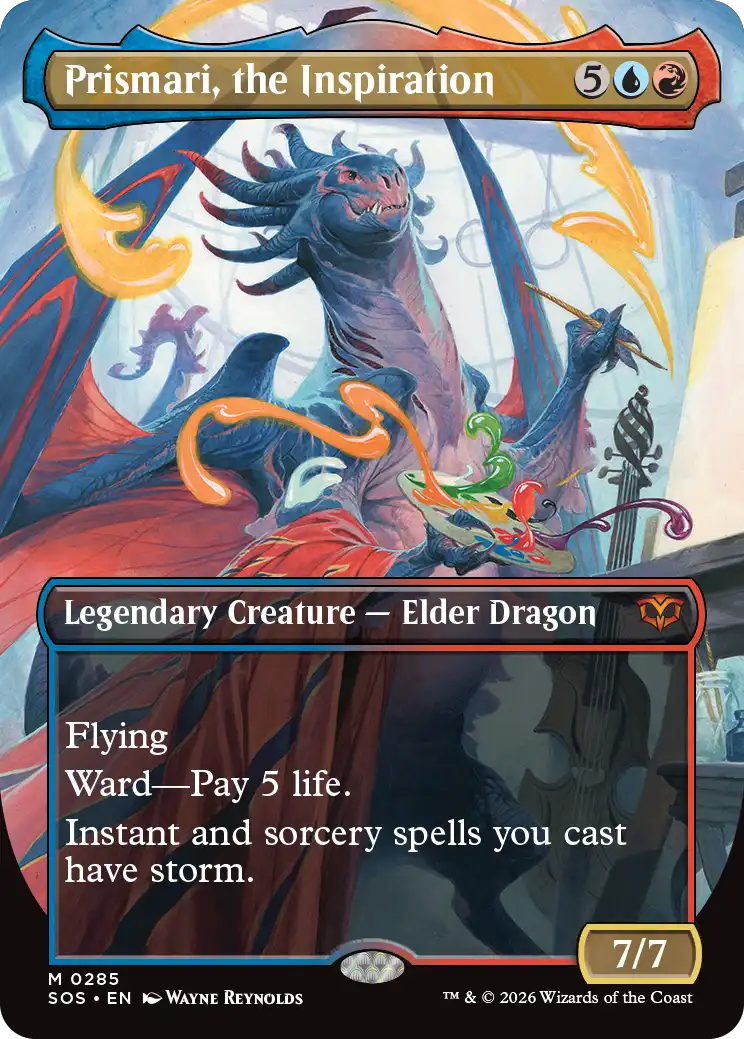
Storm is one of the most infamous mechanics in MTG history. It’s so powerful that Wizards has largely avoided revisiting it in modern design.
Storm reads:
“When you cast this spell, copy it for each spell cast before it this turn.”
Now take a second and process this:
Every spell you cast has Storm.
That means:
- Bribery: Steal multiple threats across the table
- The Last Agni Kai: Board wipe and ramp into your next turn(s)
- Relentless Assault: Multiple combat steps
- Time Warp: Multiple extra turns
This isn’t just powerful—it’s exponential!
You don’t need to build around Storm anymore. You just… play Magic, and suddenly every turn becomes a combo turn.
Witherbloom the Balancer
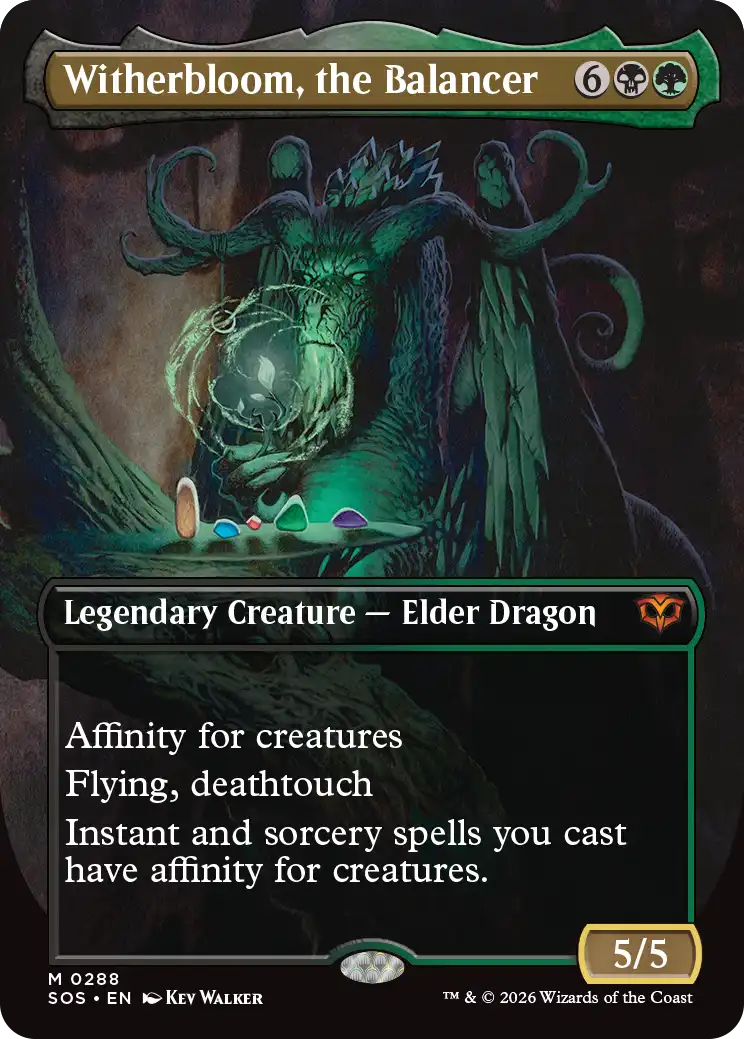
Witherbloom was the first of these Elder Dragons to be leaked, and players immediately started calling it broken—and for good reason.
Affinity reduces the cost of spells based on how many permanents you control. In this case? Creatures. In a token deck, this becomes absurd very quickly. You’re not just casting spells cheaper—you’re often casting them for almost nothing.
This commander becomes incredibly difficult to deal with because:
- It can be cast for far less than its mana cost
- It thrives in wide board states
- It turns creature-heavy strategies into spell-slinging engines
With even a modest board of creatures, you’re suddenly:
- Casting massive spells for minimal mana
- Overwhelming opponents with tempo
- Snowballing advantage, turn after turn
And if you’ve got 20+ creatures in play? Let’s just say… your spells might as well be free.
Lorehold the Historian
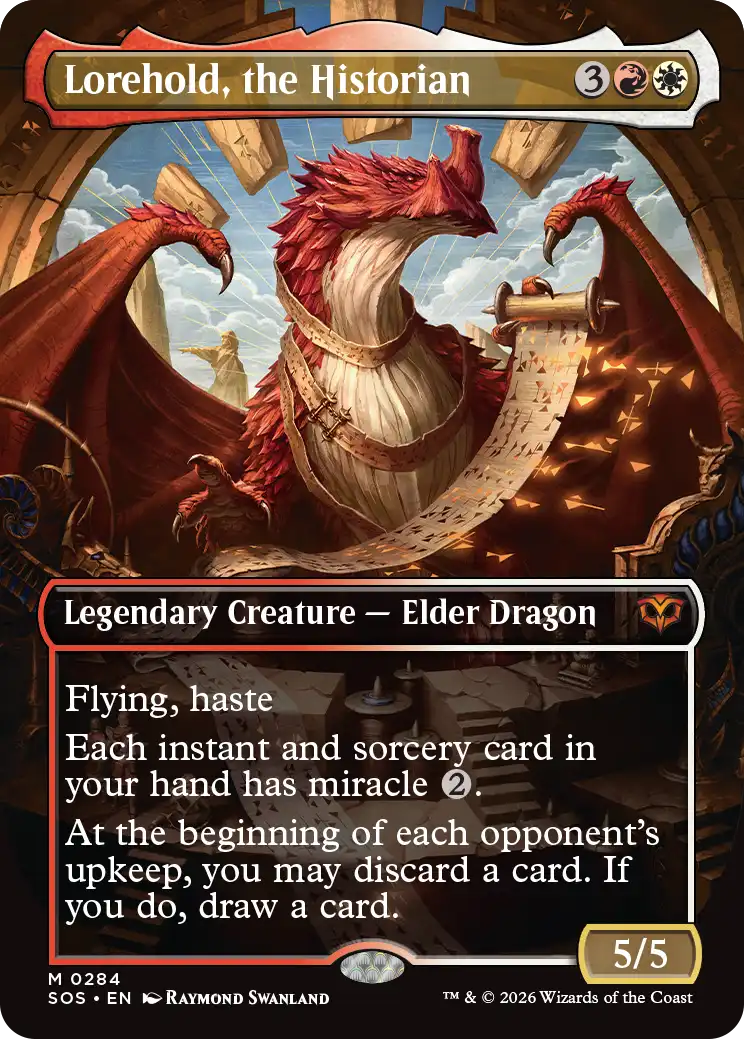
Miracle was first introduced in Avacyn Restored. Normally, it allows you to cast a spell for a reduced cost if it’s the first card you draw in a turn.
This dragon changes everything. Now, every instant and sorcery in your hand has Miracle {2}. And thanks to the built-in "loot" ability on each opponent’s upkeep, you’re constantly cycling through your deck—giving you multiple chances to trigger Miracle every turn cycle.
Imagine:
- Board wipes for 2 mana
- Massive burn spells for 2 mana
- Game-altering sorceries at a fraction of their cost
Instead of running out of gas, you’re constantly refueling—and doing it efficiently.
Quandrix the Proof
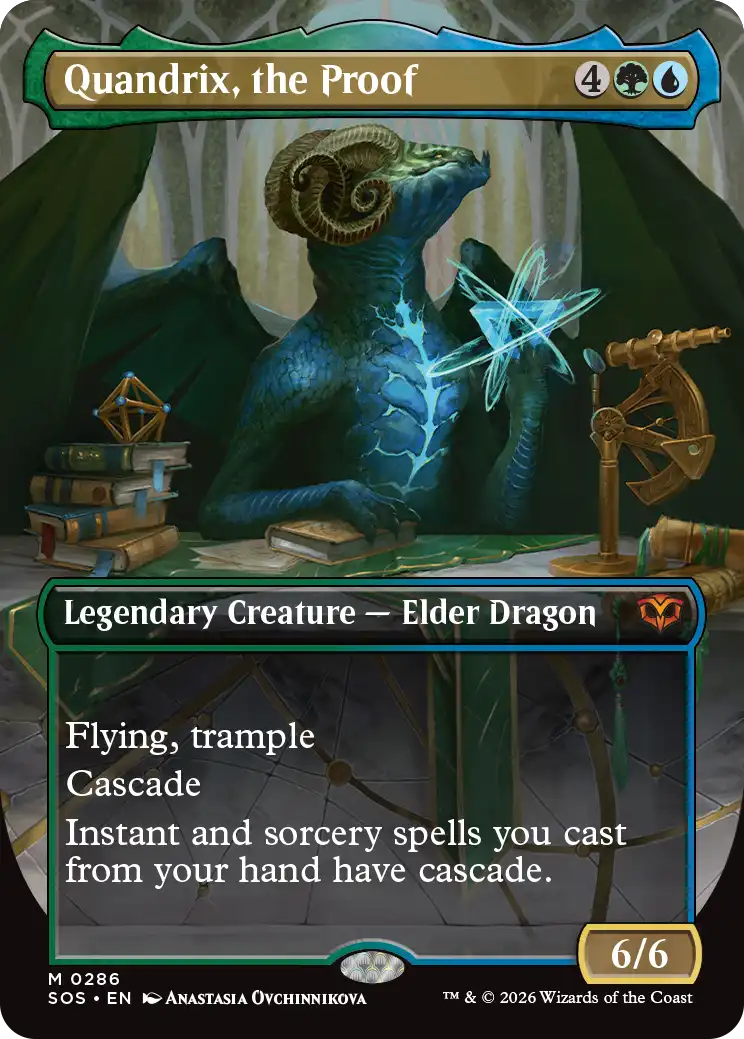
Cascade… Cascade… Cascade…
Introduced in Alara Reborn, Cascade allows you to exile cards from the top of your library until you hit a nonland card with a lesser mana value—and cast it for free.
Now apply that to every instant and sorcery in your hand. This dragon turns every spell into a chain reaction.
You cast one spell…
You get another for free > Which leads to more value > Which keeps the momentum going. It’s not just card advantage—it’s explosive sequencing.
With the right deck construction, this becomes:
- Constant pressure
- Free resources
- Unpredictable, high-impact turns
You’re not just playing your deck—you’re unleashing it!
Why These Dragons Would Reshape MTG?
Now, I’ve only been playing MTG for about a year and a half—but one thing has become very clear: Cards keep getting bigger, faster, and more impactful.
Recent sets have already pushed the boundaries of power, and precons like Blight Curse have shown just how strong out-of-the-box decks can be.
Cards like this will not only redefine Commander power levels, but will also push the limits of deck building and potentially create a new archetype overnight. And yet… that’s part of what makes them so exciting. At their core, these dragons represent what we all love about Magic: Big creatures, big spells, explosive turns, and game-ending potential.
These aren’t just Elder Dragons. They are: engines, value generators, win-cons, or perhaps even a deck all in a single card. I am sure that if you found yourself sitting across one of these monsters, you wouldnt be asking "What does it do?"
You’d be asking, “How do I survive my next turn?”

