
Author: Bill
It has been nearly a year and a half since I was first introduced to Magic: The Gathering. In that time, I’ve had the opportunity to explore a wide range of decks, cards, and strategies within the game—learning what works, what doesn’t, which cards belong in a deck, and which ones should be cut.
There is an enormous amount to learn in MTG, and honestly, I don’t think that learning curve ever truly ends. With new sets releasing every few months—each introducing new mechanics and interactions—the game is constantly evolving.
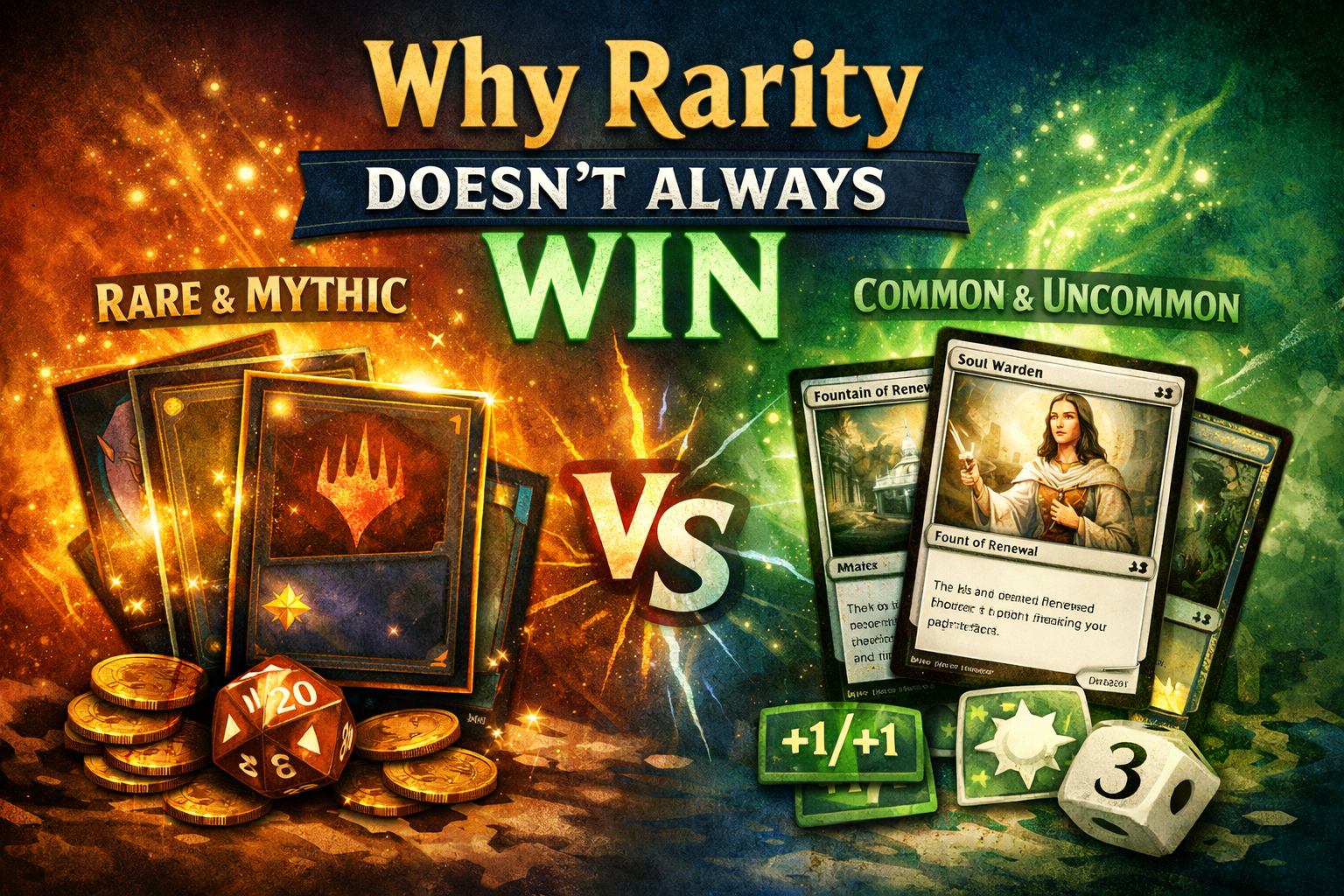
One of the most important lessons I’ve learned over the past few months, however, is that card rarity is often little more than a price tag.
As of this writing, it has been just over a week since Lorwyn Eclipsed was released. During one prerelease event, a fellow player suggested that I build a deck entirely around the rares and mythics I pulled from my sealed pool. That comment made me reflect on what I’ve learned about rarity and deck construction.
When I built my very first deck, my goal was to create the strongest lifegain, “you can’t do that” style deck possible. As I started building and upgrading it, I noticed that my choices heavily favored rares and mythics. Like many new players, I equated market price with power level. While price can sometimes be a useful reference, I’ve since learned that it shouldn’t be the foundation of your deck-building strategy.
Over time, I began replacing some of those rare and mythic cards with commons and uncommons—cards like Fountain of Renewal and Pristine Talisman, for example. As I continued playing the deck, I realized something surprising: in many situations, card B was simply better than card A.
Why? Because even though those replacements were commons or uncommons, they directly supported my deck’s core strategy. In my Heliod, Sun-Crowned deck, those inexpensive cards consistently triggered lifegain, which in turn generated +1/+1 counters. A ten-cent card ended up performing better than a five-to-ten-dollar card because it aligned perfectly with what the deck was trying to do.
Years ago, rarity may have carried more mechanical meaning. But MTG has evolved well beyond that point. Wizards of the Coast now regularly prints multiple versions of iconic cards at different rarities. Soul Warden is a perfect example—it currently exists in eight common versions, three uncommon versions, one rare, and one mythic printing.
Rares and mythics can certainly be fun, especially when you’re calculating the total value of a deck—I know that feeling well. But a high price tag doesn’t mean your deck has achieved peak performance. In fact, some of the most optimized and consistent decks rely heavily on commons and uncommons to maximize synergy and efficiency.
Building a strong MTG deck isn’t about chasing rarity or market value—it’s about understanding your strategy and choosing the cards that best support it. While rares and mythics often offer powerful effects, they are not automatically superior to lower-rarity cards. Synergy, consistency, and purpose matter far more than the symbol printed on the card.
In the end, the best deck isn’t the most expensive one—it’s the one where every card earns its place.

